ServicesDrywall Hanging
Drywall Hanging in Harrison, NJ
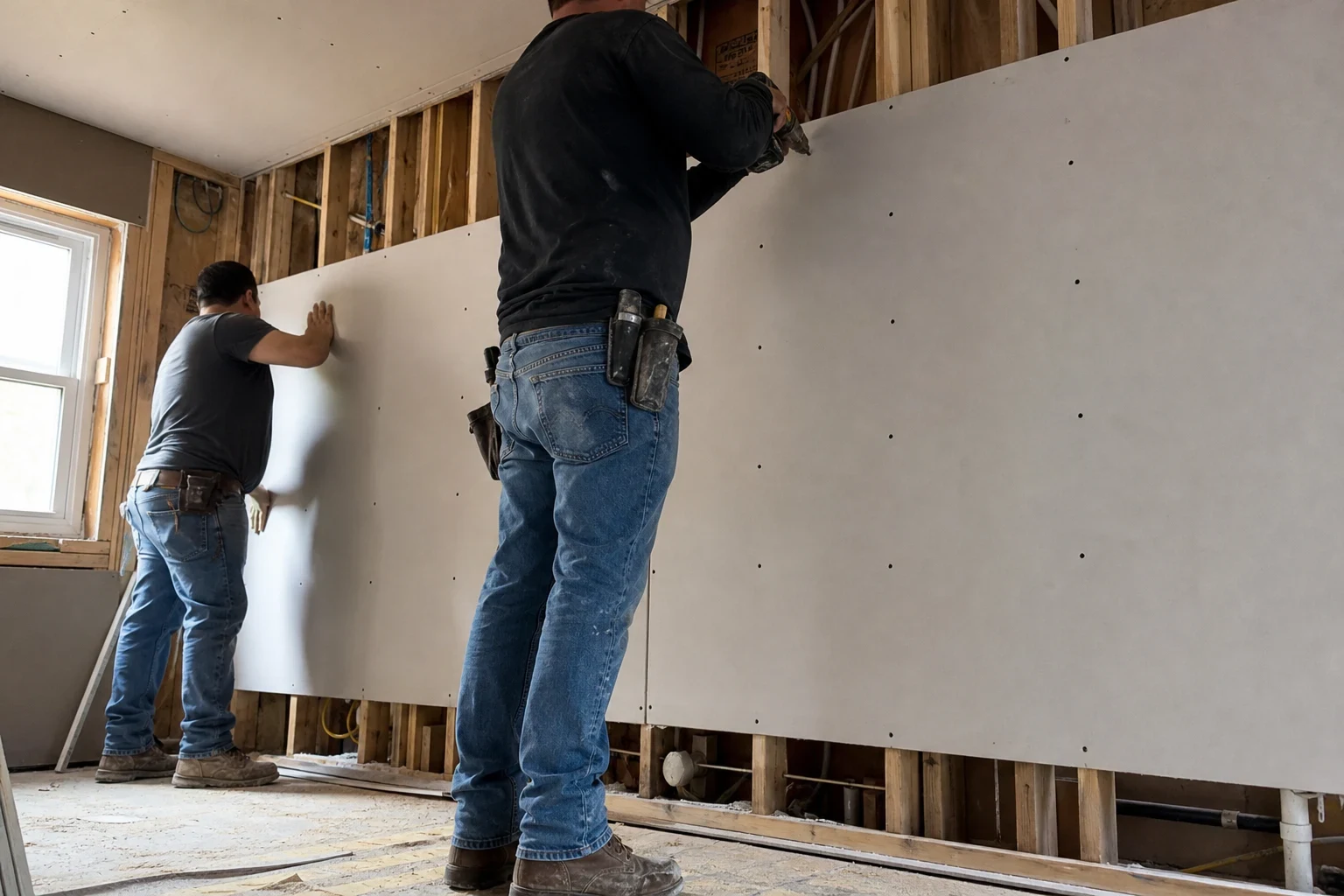
We hang new drywall on walls and ceilings, from a single room to a full basement. We pick the board for each space, whether that is fire-rated, moisture-resistant or sag-resistant ceiling panel. Then we fasten it so the finish stays flat for years.
New board, chosen for the room it goes in
Drywall hanging is the step between open framing and a finished wall. It covers a gutted room after water damage, an old plaster wall taken down to the studs, a finished basement or an attic conversion. If the damage is limited to a section of an existing wall, drywall repair or drywall patching is usually the better call.
Not every sheet of drywall is the same. Standard 1/2-inch board suits most interior walls. 5/8-inch Type X has glass fibers in the gypsum core and resists fire longer, so code calls for it on the wall and ceiling between an attached garage and the living space. Moisture- and mold-resistant board belongs in bathrooms and laundry rooms. Sag-resistant 1/2-inch ceiling board holds its shape between joists that standard board can bow across.
Many older homes around Harrison have framing that has shifted over the decades, so we check the studs and joists before the first sheet goes up. Board hung over a crooked stud shows every wave once it is painted.
What our drywall hanging covers
Framing check before hanging
We run a straightedge across the studs and joists to find high and low spots. Uneven framing gets shimmed or planed so the board lies flat.
Board selection by room
We walk you through the choices: standard, Type X, moisture-resistant, mold-resistant or sound-dampening board. You get the reason for each one, not just a line on the estimate.
Overhead work comes first
We start with the ceiling. Once those sheets are fastened, the top row of wall board slides up tight beneath them and helps hold their edges in place. In most rooms the wall sheets run horizontally, which means fewer feet of seams to tape.
Layout that puts joints in the right places
We stagger butt joints and keep seams away from the corners of doors and windows, where framing movement cracks tape first. Longer sheets mean fewer butt joints, and those are the hardest to finish flat.
Correct fastening
We use drywall screws set just below the paper face without tearing it. Spacing runs about 12 inches on ceilings and 16 inches on walls, and adhesive goes on where it helps reduce screw pops.
Corner bead and ready-to-finish board
Outside corners get metal or paper-faced bead, so the room is ready for taping. Our drywall finishing work can carry it through to a smooth, paint-ready surface.
Signs it is time for new drywall, not a patch
Water soaked the lower wall
Gypsum that has been wet for days loses strength and can grow mold behind the paper. Cutting out to a clean line and hanging new board is more reliable than patching over it.
Ceiling sagging between joists
A bowed ceiling tends to point to one of two causes: board that was undersized for how far apart the joists sit, or board that soaked up moisture. New sag-resistant board deals with the cause instead of hiding it.
Cracked or crumbling plaster
When old plaster is pulling off its lath across a whole wall, new drywall over the studs is often cleaner than repeated patching.
Open framing from a remodel
A finished basement, attic room or new partition wall needs board before anything else can happen.
Garage wall without fire-rated board
If the shared wall or ceiling with an attached garage has standard board or none at all, Type X is the right material there.
How a hanging job runs
- 1
Measure and talk materials
We measure the rooms, check the framing and explain which board fits each area and why. You get a written, line-item estimate by sheet type and labor.
- 2
Protect your home
We cover floors, seal doorways with plastic and set up a clean work area for cutting. Sheets come in through the shortest path to limit wear on halls and stairs.
- 3
Hang and fasten
We work overhead before moving to the walls, with cuts made tight around outlets, switch boxes and fixtures. We check screw depth sheet by sheet so nothing sits proud or breaks the paper.
- 4
Walkthrough and cleanup
Before we leave, we walk the room with you and point out the joint layout. Scraps and dust go out with us, and the room is ready for taping.
What moves the cost of drywall hanging
Price follows the square footage, the type of board and how hard the space is to work in. We put each part on the estimate so you can see where the money goes. Get your quote by phone and we will set a time to measure.
- Board type
- Type X, moisture-resistant and sound-dampening board cost more per sheet than standard 1/2-inch. 5/8-inch board is also heavier and slower to hang.
- Ceilings and tall walls
- Overhead sheets and tall walls need a panel lift or scaffolding and more labor per sheet.
- Framing condition
- Uneven or damaged studs need shimming or correction before hanging, which adds time.
- Access and room layout
- Narrow stairways, small rooms with many openings and lots of outlet cutouts all slow the work compared with long, open walls.
- Permit requirements
- Larger jobs, especially fire-rated assemblies, can need a permit under the New Jersey Uniform Construction Code. We tell you up front if yours does.
Drywall hanging questions
Something not covered here? (973) 397-5568
Does hanging include taping and mudding?
No. Hanging ends once the board is up, fastened and the corner bead is on. Tape, joint compound and the sanding between coats fall under drywall finishing, a separate service we offer. Having the same crew handle both means nobody can blame the other trade for a seam that shows through the paint.
Should I use 1/2-inch or 5/8-inch drywall?
For most interior walls, 1/2-inch is fine. 5/8-inch Type X is required between an attached garage and living space and is a good choice where you want more rigidity or a bit more sound control. On ceilings with wide joist spacing, we use 5/8-inch or a sag-resistant 1/2-inch board.
Is green board enough for a bathroom?
Moisture-resistant board works well on bathroom walls and ceilings away from direct water. It is not meant for the inside of a tile shower, which needs a cement board or a proper waterproofed backer. We point out which areas need which material.
Can you hang drywall over old plaster?
It depends on the plaster. Where it is still firmly keyed to the lath and close to flat, a thin 1/4-inch board can be laminated right over it. Plaster that is loose or bulging has to come off first, so the new sheets bear directly on the studs.
How long does a typical room take?
An average bedroom is often hung in a day, depending on ceiling height and how many openings there are. Finishing adds several more days because each coat of compound has to dry.
Ready to choose the board for your project
Tell us about the rooms and what happened to the old walls. We will explain the materials that fit and set a time to measure.